
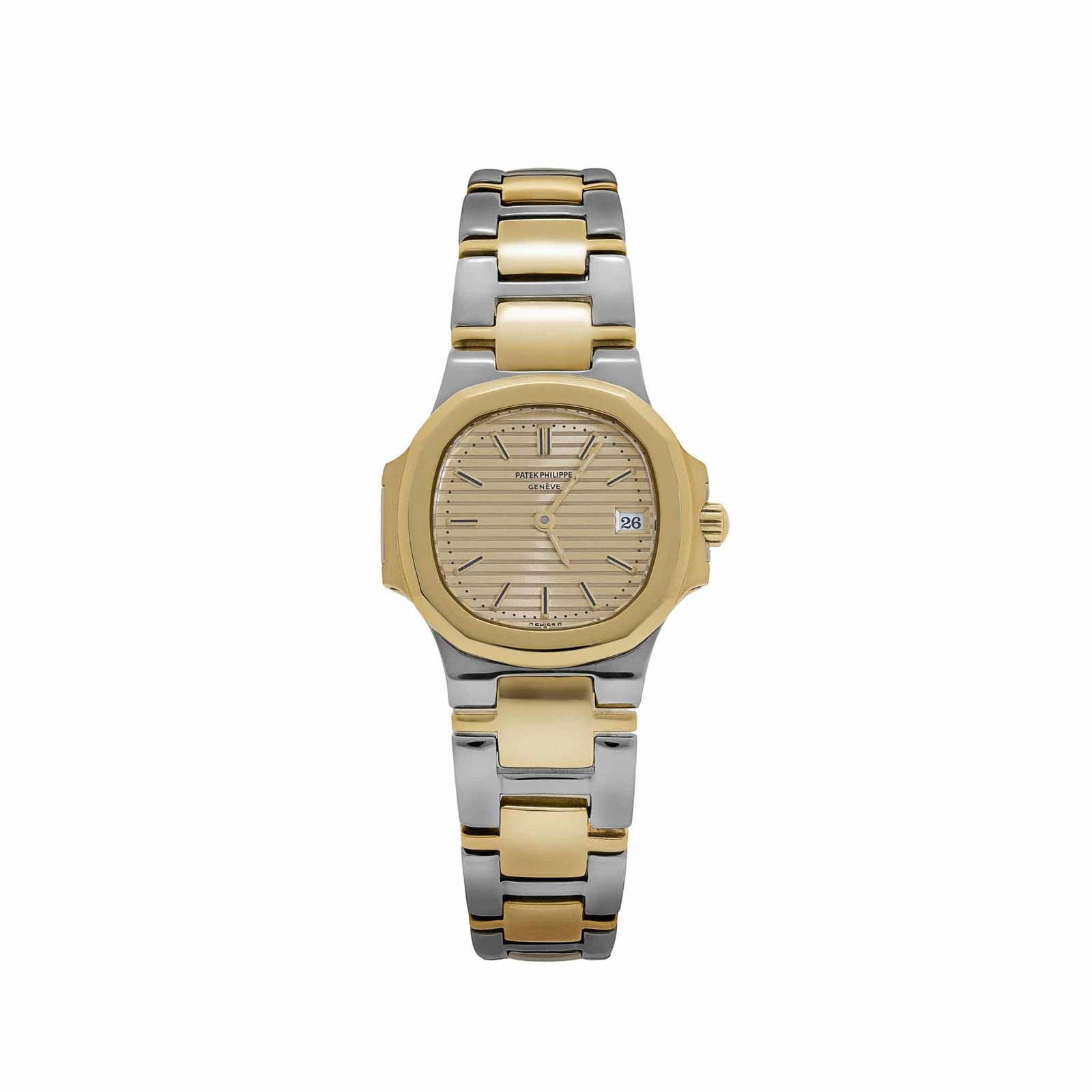
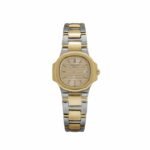

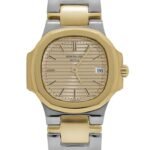

Patek Philippe Nautilus 4700/51 ‘Ladies’ Stainless Steel Yellow Gold Champagne Dial Quartz
₨ 24,000
Product Information
The Patek Philippe Nautilus 4700/51 represents the Ladies’ Nautilus in its original two-tone configuration — a reference that brings Gerald Genta’s 1976 porthole design to a smaller case with the added material warmth of yellow gold details against the stainless steel body. Produced from the mid-1980s through the 1990s before the current 7118 and 7010 generations succeeded it, the 4700/51 occupies a specific moment in the Nautilus’s evolution when quartz movements were considered the appropriate technology for a ladies’ sports-luxury watch of this scale, and when the two-tone steel and yellow gold combination was at peak desirability across the entire industry. Today the reference attracts collector attention both for its historical position within Nautilus production history and for the elegance with which the yellow gold bezel and bracelet centres integrate with the champagne dial’s warm tonal register.
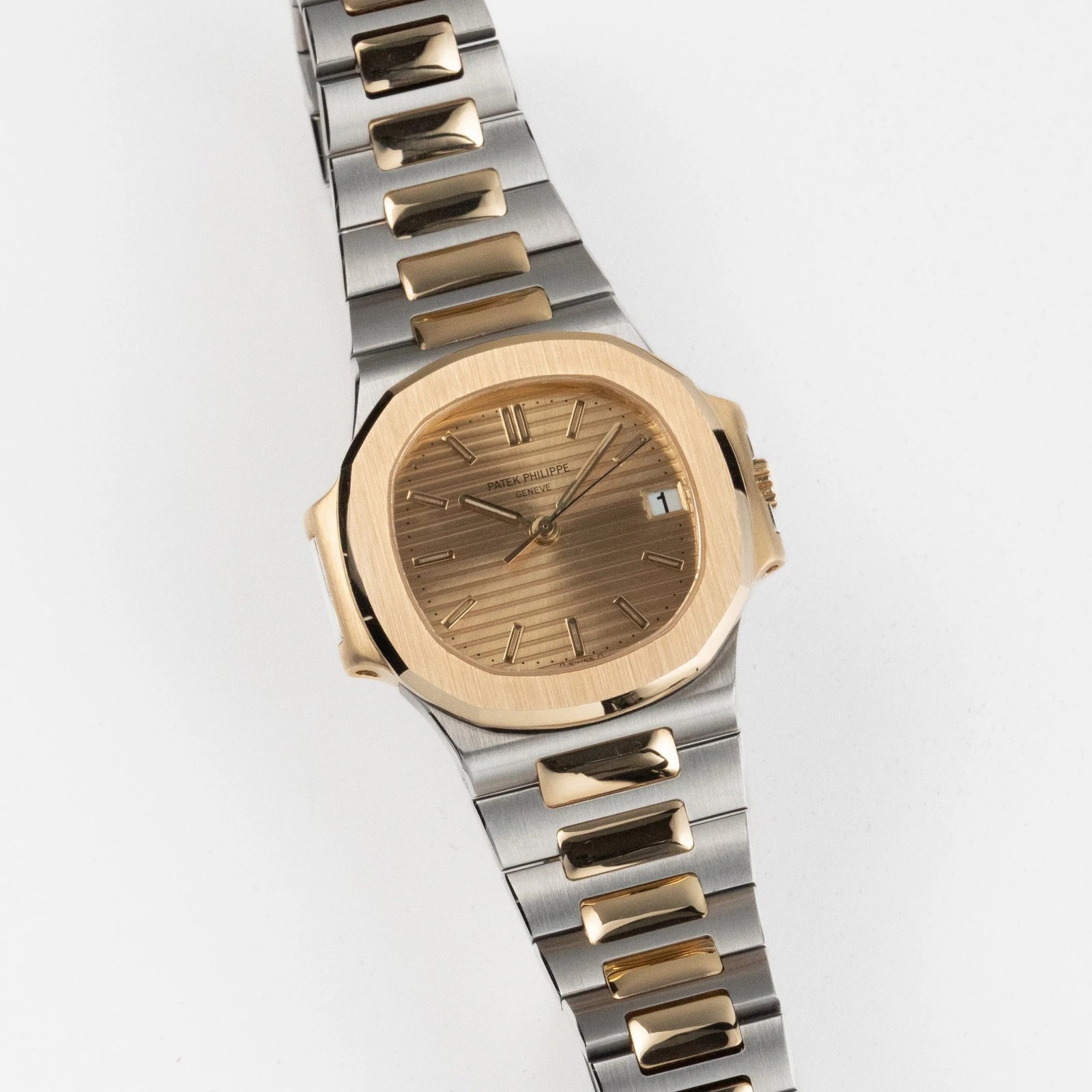
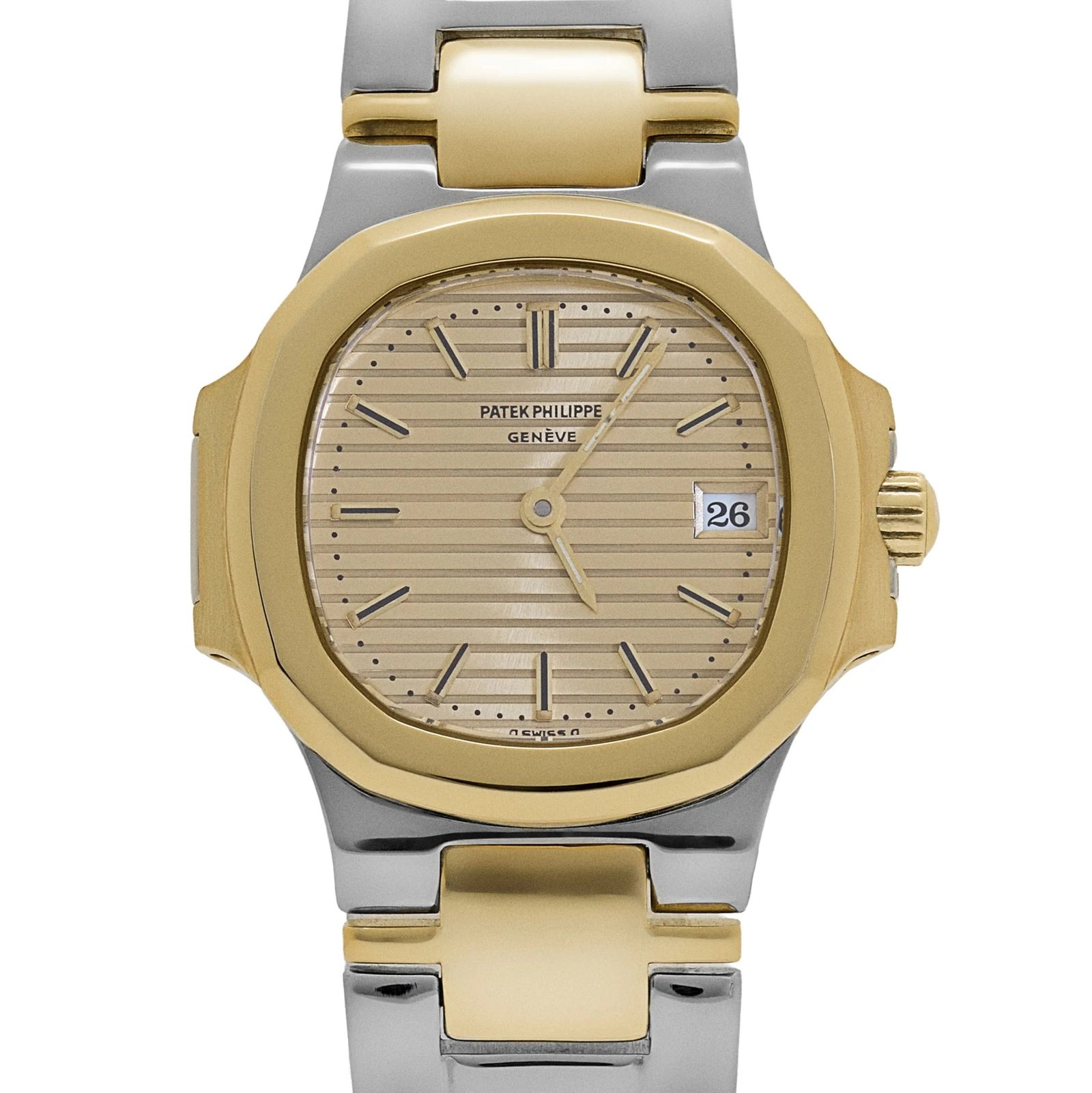
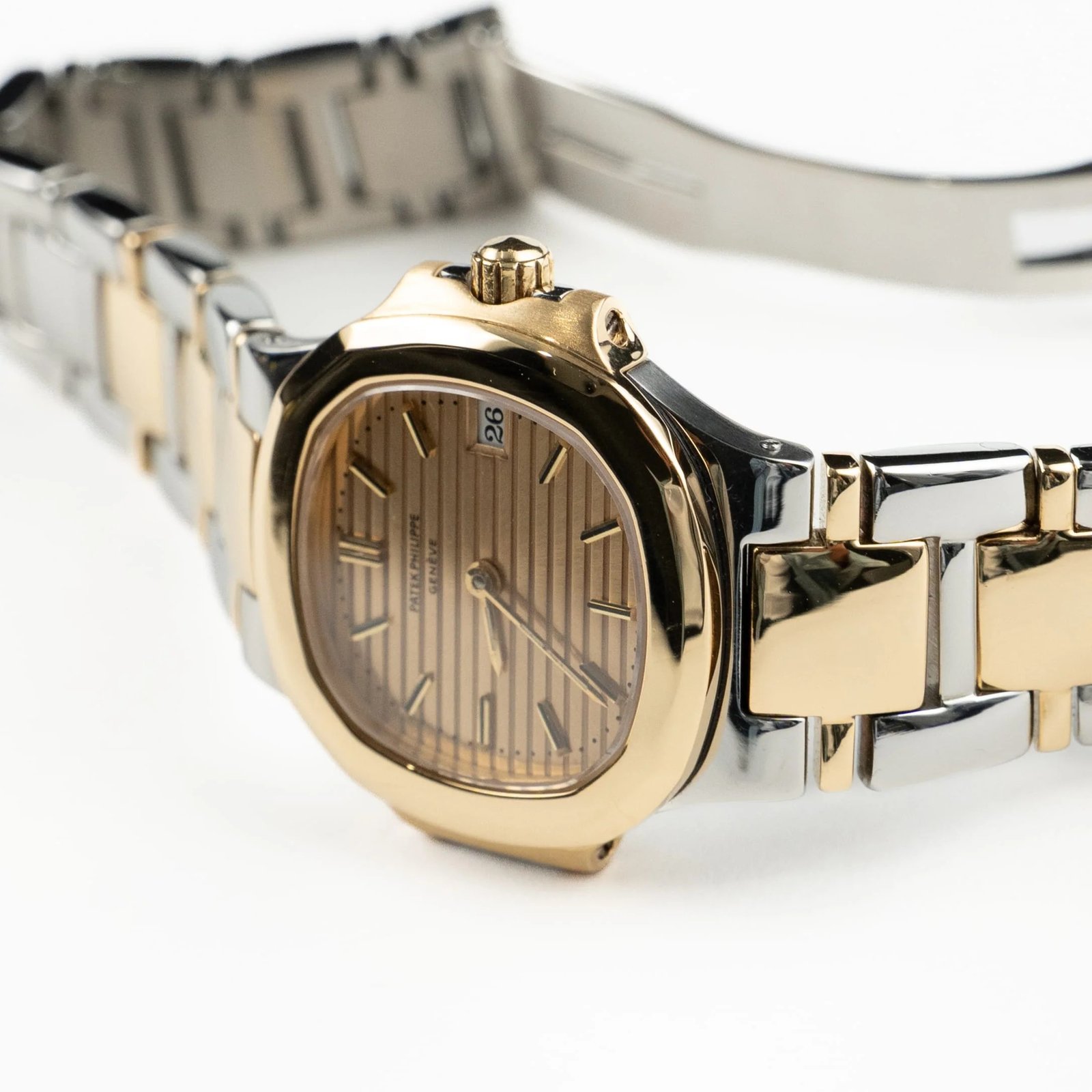
The 27mm stainless steel Nautilus case carries a yellow gold bezel, with the characteristic porthole-form octagonal profile and integrated ear lugs. The champagne dial presents the Nautilus’s signature horizontal embossed relief pattern, gold baton hour markers, and a date aperture at three o’clock. Gold leaf hands complete the dial. The integrated stainless steel bracelet features polished yellow gold centre links flowing from the case, with a fold-over clasp. A Swiss quartz movement powers the watch.
*We ordered Archive Papers from Patek Philippe and are currently waiting for them.
Learn more
The reference 4700 is the Nautilus’s own origin story, told in a smaller format and with a material vocabulary that the original reference 3700 did not employ. When Gerald Genta’s steel sports watch for men was introduced in 1976, its reception was uncertain — the price was high, the case at 42 millimeters was large, and the concept of a steel sports watch commanding the same attention as a fine dress watch in precious metal was not immediately embraced by the retail market. In 1980, Patek Philippe introduced the reference 4700 to address a different constituency: the ladies’ Nautilus, quartz-powered, at approximately 26 millimeters, with the Nautilus’s fundamental design intact — the octagonal bezel secured by visible screws, the horizontally embossed dial, the integrated bracelet whose link construction flows from the case without visual interruption — but adapted in scale and material for a watch that would function as a ladies’ everyday timepiece rather than as a men’s sports watch. The reference 4700/51, the two-tone configuration in stainless steel and 18-karat yellow gold with a champagne dial, is among the most desirable expressions of this family within the vintage collecting market, its steel-and-gold material program producing a specific visual quality that neither all-steel nor all-gold configurations achieve.
The two-tone Nautilus formula — stainless steel for the case body and the structural elements of the bracelet, 18-karat yellow gold for the bezel, the bezel screws, and the bracelet’s center links — was not exclusive to the reference 4700 within the Nautilus family, but it achieves at the ladies’ scale a particular visual balance that is different from the men’s two-tone configurations. At 27 millimeters, the proportional relationship between the case body’s steel surfaces, the yellow gold bezel, and the bracelet’s alternating steel and gold links is more concentrated and more intimate — the gold and steel elements closer together, their interaction more apparent at the wrist proximity appropriate to a watch of this size. The bezel’s yellow gold, with its four securing screws at the corners — the screws that are, along with the horizontal dial embossing, the Nautilus’s most immediately recognizable design signatures — provides the warm metal accent that defines the watch’s material character, the gold brightness against the steel body creating the specific two-tone luxury sports watch aesthetic that the late 1970s and 1980s established as a category and that remains, in genuinely well-preserved examples, as persuasive as it was at its introduction.
The champagne dial is the two-tone configuration’s natural companion — neither the silver-white that would register as cool against the yellow gold bezel nor the deep blue that would create a high-contrast statement, but the specific warm neutral that sits between ivory and gold, carrying just enough warmth to harmonize with the yellow gold without matching it. The horizontally embossed pattern — parallel relief lines running from left to right across the dial’s surface, each line creating a slightly raised ridge that catches light along its length — is the same fundamental design element that has appeared on the Nautilus dial since 1976, present here at the ladies’ scale with the proportional calibration appropriate to a 27-millimeter dial rather than a 42-millimeter one. The embossing at this scale is finer and denser, the individual ridges narrower in proportion to the dial surface they occupy, the overall effect a texture of greater subtlety than the men’s versions produce. Yellow gold baton-style hour markers and yellow gold hands provide the time display, their warm gold tone completing the dial’s warm-neutral composition without introducing any chromatic element that would interrupt the champagne-and-gold harmony. The date aperture at three o’clock — its white disc and black numerals the sole sharp-contrast element in the otherwise tonally unified dial — provides the calendar function with the practical legibility that the overall composition’s warmth would not otherwise produce.
The movement is the Calibre E19C, Patek Philippe’s quartz calibre for the ladies’ Nautilus family of this era: seven jewels, battery-powered, calibrated for the absolute precision that quartz provides without the positional or temperature variation that a mechanical movement would require. In a watch produced for everyday wearing at this scale — a watch that lives on the wrist continuously, worn from breakfast through the evening and returned to the wrist the following morning — the Calibre E19C is the correct movement in the same sense that quartz is the correct movement for the Twenty~4 and the Cartier Panthère: the calibre that provides unconditional accuracy, requires no daily winding engagement, and allows the wearer to concentrate entirely on wearing the watch rather than on maintaining it. The solid caseback protects the movement without the display function that a sapphire caseback would provide.
The integrated bracelet in stainless steel and yellow gold alternates the two materials according to the pattern established for the two-tone Nautilus family: the bracelet’s outer links in steel, the center links in gold, the sequence producing a bracelet that reads from a distance as a warm gold surface and reveals at close range the alternation of cool and warm that gives the design its depth. The bracelet’s folding clasp closes the watch against the wrist with the deployment mechanism appropriate to everyday wearing. At 27 millimeters, the bracelet’s link proportions are calibrated to the case dimensions with a precision that makes the transition from case to bracelet invisible, the case’s own lug profile matched to the bracelet’s first link in the seamless integration that was, in the reference 4700’s era, among the most sophisticated aspects of Patek Philippe’s bracelet engineering.
The reference 4700/51 in well-preserved condition is, within the current ladies’ vintage Patek market, an object whose appeal has proven consistently durable rather than historically contingent. The two-tone material program, the champagne dial, and the Nautilus case design together constitute a combination that was recognizable at the time of production as sophisticated and that remains so today — not because taste has stood still but because the specific material and formal qualities of the combination are genuinely resolved rather than merely fashionable. Wear, patina, and the particular warmth of aged yellow gold against aged stainless steel contribute to the appeal of a well-worn example in ways that new production cannot replicate, the watch’s history on the wrist becoming a visible quality rather than a liability. For the collector of ladies’ vintage Patek, the 4700/51 is among the most versatile and most consistently desirable references in the Nautilus family’s production history.
100% Authenticity Guarantee
Every timepiece we offer is thoroughly verified to ensure абсолют authenticity and exceptional quality. While we are not an authorized dealer, we source our watches from a carefully selected network of trusted partners, collectors, and industry professionals who work closely with original manufacturers and official boutiques.
Each watch undergoes a detailed inspection by experienced watch specialists, confirming its performance, originality, and that all components align precisely with its serial number and accompanying documentation. This ensures you receive a timepiece you can trust with complete confidence.

Warranty
All new and pre-owned timepieces are backed by either our complimentary 1-year warranty or the remaining coverage from the original manufacturer, where applicable. Our warranty is designed to cover any mechanical issues resulting from manufacturing defects, ensuring your watch performs as intended.
Please note that this coverage does not extend to cosmetic wear, normal aging, accidental damage, loss, theft, or issues caused by misuse or water exposure. Any repairs, servicing, or modifications carried out by third parties after purchase will void the warranty.

Concierge Service
We are committed to delivering a truly personalized luxury experience. Your journey begins with a simple inquiry — whether through a boutique visit, phone call, message, or email. From there, a dedicated specialist will guide you every step of the way, helping you discover the perfect timepiece tailored to your preferences.
